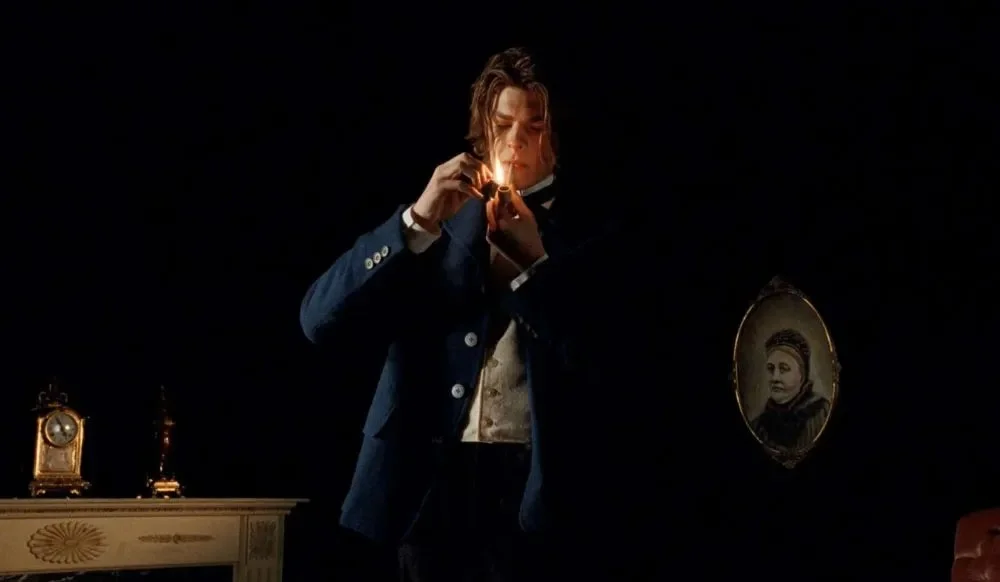
If you told most people “hey, have you seen the new biopic about Arthur Rimbaud? It contains only one actor walking around abstract, minimalist sound stages, as he narrates a monologue of one-sided dialogue. He interacts with multiple unseen characters whose reciprocating lines of ‘dialogue’ are represented by the sound of various instruments playing arpeggios. Oh, did I mention it’s three hours long?” they might run screaming. Let those trendy, unadventurous TikTok kids who whine about how ‘anybody who claims to love a black and white foreign film is pretentious’ find out that movies like this exist. (Hey, who knows, it might break something in their brains in a good way.)
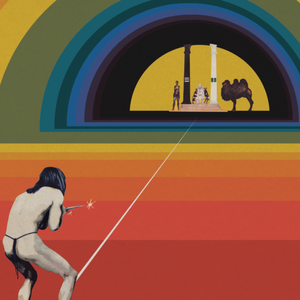
Patrick Wang’s A. Rimbaud (2026) is as wonderful as it is painful; a movie that is truly earnest, bizarre, funny, challenging and abstract in a way we rarely see outside of an off-off-broadway stage or modern art museum installation. The closest cinematic comparison might be the slow, surrealist works of Albert Serra, with a visual touch of Lars Von Trier’s Dogville – though both look almost downright conformist in comparison to this. A. Rimbaud is the rare biopic that truly breaks the mold, using its unconventional style to mine for a deeper truth about its subject and visually capture the spirit of his poetry. To put it more bluntly, it’s kinda punk rock.
And let me tell ya: it’s not an easy watch! Despite my high tolerance for artistic abstraction and cinematic nonsense, I struggled for a good while to settle into A. Rimbaud’s vibe – its rambling monologues that cut off abruptly, sometimes mid thought, only to shift into poetry recital. How it weaves in and out of the story in a way that’s only just linear, yet no adherent to the conventional laws of time; sometimes whole weeks pass in a matter of seconds, represented only by lighting changes. Other times, time crawls by so slowly you could swear the past fifteen minutes were a half hour. It’s not just the lack of visual stimulation, it’s the monologue overstimulation mixed with surrealist, mildly atonal musical responses. The way it all melts into one big cacophony of rhythmic recitation and random orchestral noise – it’s like Peanuts on LSD. Which isn’t to say it’s any fault of the actor, the central and, well, only performance by Blake Draper is incredibly strong. You can feel his energy shift and morph along with his accent as the movie goes on, starting with Rimbaud as a 14-year-old and ending with his death at 37. Draper’s ability to emote against nobody is impressive, and his performance keeps the film grounded and recognizable on a base emotional level, even when you’re not entirely sure who he’s meant to be talking to.
The inevitable confusion about who’s who and what’s happening is probably the biggest flaw of the film. Though I almost hesitate to call it a true flaw, as it’s also in some ways its biggest strength. If you know enough about Rimbaud to recognize the names of the main players in his life, you’ll likely do just fine. If you don’t, you will learn through the movie, even though it will feel tenuous as most of the characters never get proper introductions. We only see how Rimbaud reactes to them; how he struggled with or longed for them, criticized or praised them. His mother, stingy and cold but ultimately supportive. His peer and lover Verlaine, tempestuous and moody. His sister Isabelle, sweet and doting. The names gets muddier once it turns into a parade of supporting characters, mentors and protégés, or kings and merchants of Abyssinia. The movie throws you into the deep end so that you find yourself both understanding what’s happening and never feeling like you truly got it all. I went into this film as only a passing fan of Rimbaud, one who probably knows more about the contemporary musicians and artists his work inspired more than the man himself. After the movie I felt compelled to read his life summary on Wikipedia in order to see what I missed, though I found that the movie was actually pretty straight forward – the real haziness was just my own irrational sense of self doubt.
Which brings us to the true brilliance of this film; its insight into the tenuous balance between our youthful creative drive and the soul-crushing anxiety of adulthood. With A. Rimbaud, Wang forces his audience to probe Rimbaud’s brilliant and troubled psyche in order to test the limits of their own – feel the real thrill of embracing the unknown, throwing convention to the winds, and then force us through witnessing Rimbaud’s decline to confront the fears that curtail our own greatness. Rimbaud’s journey from romantic enfant terrible to workaholic colonial trade merchant feels like less of a surprise when you watch it play out over three hours. It’s the same story we’ve seen time and time again, the one that created the contrived adage about how it’s ‘natural’ for young people to start liberal, then eventually ‘mature’ into conservatives.
But A. Rimbaud doesn’t let you dismiss any part of Rimbaud’s story as simple or inevitable, instead it portrays his evolution as complex and heartbreaking. A young man passionate about living, willing to throw convention to the wind in search of never ending love and beauty, only to be met by a world of violent rejection and selfish indifference that demands he submit to its will or die trying to escape. Now no longer a teenager, burnt out and damaged from betrayal and heartbreak, Rimbaud instead disappears into a completely different society and a world of unending work. He abandons his ideals for a semblance of stability and a superficial shield from emotional upheaval. He tells himself that he sees poetry in this new work, in the languages he learns and in the planning of his trades, as a way to justify his actions. And while it’s not a complete self-abandonment, it is the mark of a calcified soul – a product of time, fear and calculated inhibition. Now living without love or emotional need of others, he settles down and sells out.
By the time we get to Rimbaud’s early death, right at a time when his abandoned poetic works suddenly have a resurgence among his Parisian peers, you can’t help but feel emotional. Sad for the death of somebody so young. Sad for the spiritual death of somebody who once strived for more. Grateful for the endurance test of this film to force you to feel every moment of it in all of its beauty, boredom, disappointment and glory.